Wednesday, November 21, 2012

Flash FIction


1. He stood on the edge of the cliff. After taking one last look at the flower next to his bare feet, he took a step forward.

2. During the worst famine of the century, my neighbor’s dog lost its voice.

3. The last thing she saw was the beautiful red blossoms on her shirt.

4. My father paid 500 dollars for a book titled, “199 ways to detect business fraud”.

5. For Sale: SAT books, used less than one month.

6. The kid next to me accidently dropped his ice cream. I covered my ears.

7. At the age of 52, I took out my basketball shoes once again.

8. Lord Dracula’s vintage winery: 32 year old Italian for only 40 euros.

9. A tribe called seiranoisiV did exactly the opposite they were educated to do at school: they foolishly pursued their childhood dreams.

10. There is at least 1984 reasons why writing is important.


Hmm...I wrote this before I saw Seungin's and never had the idea to write one about KMLA. Maybe I should try it sooner or later. 

Wednesday, November 14, 2012

Frankenstein's view on the issue of Stereotypes


Frankenstein's view on the issue of Stereotypes
WIQ After-Dinner Speech

     Ladies and gentle monsters, it is my greatest pleasure to be here talking to you all. I would like to give special thanks to Lord Dracula who has provided us with vintage drinks from his own collection. Now as the civilized members of our society we have gathered here this lovely evening, and you may be wondering why. I, Frankenstein, felt the need to address the increasing problems that we face in the twenty first century.

     In my early years, I have traveled to various countries. Being born in a lab in the University of Ingolstadt, I have traveled to Geneva, the Alps and even up to the glaciers of the North. In those days, all was fine. Everywhere I went, people were scared of me for who I was. They would find horror in the things I did and the things I said instead of the scars or the color of my skin. I was a proud monster, not well known, but respected for being myself. But somewhere in the process of modernization, things began to change. The story of my creation began to spread, thanks to Mary Shelly, and people started asking me to star in movies. I refused of course. How silly would it seem, for a respectable monster to appear on television! But that was one of my biggest mistakes.


     The humans eventually decided to dress up another human as me. Oh, the terror. I swore the first time I saw the movie that I shall kill who ever decided to call that ugly, despicable creature with my name. What’s up with the bolts? The green skin? Really? I mean, I had scars in my old days but even that has been long gone since plastic surgery has developed. (For those of you ladies who are interested, Korea is hands-down the best). The most disturbing thing though, is that they picture me as if I am some illiterate monster with speaking issues. The so called Frankenstein’s in the movies go around saying “arghh….!”(Arm Gesture…), and how cliché is that? But the human society seems to believe that it is okay to defame me with those so called “films”. Why? Because we are not one of them. Because we are different. We may not share the same values or cultures, especially in the dietary aspect, thankfully, but we are also inhabitants of the earth and I say that we deserve equal rights.

     I accuse the media of the human society as the source of such stereotypes against us. Just about a week ago, kids were running around in green paint and bolts glued to their necks saying “trick or treat”, and they seem to think that's scary! All this is because of the media that portrayed me with such an image! Many of you comrades would also have faced such problems. Even Lord Dracula who provided us with the magnificent beverages suffers from all the twilight syndrome and whatnot. Dating with their lunch!


     The real problem is, surprisingly, that the public doesn't care about the truth. The original story of me, written by Mary Shelly, contains nothing about a green folk with limited vocabulary and a bolt stuck in his neck. Actually it is quite an accurate description of the well educated and civilized monster that I am. But nowadays the human governments are censoring the truth by classifying such books as “classics”. For them it is better for us monsters to remain as a terribly uncivilized species. By inducing fright against us in the public, the government can most effectively take care of any mistakes by turning the blame on us. How simple is that? In the past, the western humans would use this policy against other human beings. But in the modern days, with less of their own species to pick on, they have turned their eyes to us.

     I say that the situation is urgent. The best solution is to get humans to read books. But, we all know, that’s impossible. Instead, what we could do is to hunt down the people who are insinuating the idiotism of the public. Oh no, not the politicians, at least not this time. It is the media that I would like to accuse. We monsters need to get together to solve this problem. But the issue is complex and requires careful planning. We need to take time to slowly change the perspective of the humans. After all we are civilized aren’t we? So until then, ladies and gentle monsters, eat, drink and be scary. 

Thursday, November 8, 2012

Ben X Review--The beginning


     The beginning of the movie Ben X was--how should I put it?--interesting. Combining it with scenes of gaming, the beginning of the movie introduced the main character to us. The way he looked at real life and how he would compare it with is experience in the game was creative. Also the fact that his status in the game was so different from his status in his real life increased the dramatic characteristic of the movie. The first thirty minutes of it set up the characters and from the part that we saw, it seems that he would either become violent or commit suicide. 

[Earthlings Review] The dilemma of raising an issue

The dilemma of raising an issue--how we should approach it

Imagine that one day you come home for dinner and find out that every single dish was full of a vegetable named pathos. For some people, that might be exactly what they have dreamed of. But for the majority they would be heading towards the kitchen to look for some meat, or in this case, logos. The documentary, “Earthlings” was similar to this in my case. In five different sections of pets, food, clothing, entertainment, and scientific research, the film shows repelling scenes of animal abuse. Some critiques praise the documentary film as a portrayal of reality that people don’t want to see. Many reviews of this film accuse such enterprises that participate in animal abuse and the government that is overlooking the reality. On the other hand, there are people who accuse the director of “Earthlings” for selectively editing scenes and omitting any explanation that could defend these “slaughterhouses”. For either side of the debate, however, the director harmed the value of the documentary by focusing too much on the value of pathos and neglecting logos in the process.


The people who accuse this film as being propaganda point out the fact that many of the scenes would be understood differently if one was aware of the whole situation. The director however, pieced together the worst shots of the worst places in our society. For instance, taking street animals into captivity and killing them in a perhaps, violent way happens in the first place because of the irresponsible people who abandon their pets. These animals living in the streets become agents that spread diseases over the city. Furthermore, these animals themselves suffer from starvation and inhospitable environments. Thus, taking them into captivity is inevitable to protect the public health and also protects the animals as well. The violent murder of these animals, however, does happen in reality because of the lack of financial support for anesthesia. Whether the public health is worth the suffering of these animals is a reasonable topic to debate on. The main problem of “Earthlings” is that it leaves no room for such debates from the beginning.
The last part of the story which discusses animal experimentation is also based on ignorance of the purpose and value of animal vivisection. Unlike what the documentary argues, animal testing does have scientific value in medical testing. History has proven the effectiveness of vivisection compared to testing on cells cultivated in labs. Although the actual effects of a certain treatment may differ from humans and animals, the purpose of vivisection—to minimize danger for human beings—has been fulfilled. Also the film mentions that such experiments have to be redone on human beings. This apparently shows that they agree on vivisection itself but denies the use of animals in the process. Along with the selective editing of shots taken from the few labs that don’t follow the universal doctrine for animal vivisection, such problematic ideas presented in the documentary destructs its own credibility because it relies too heavily on dramatic scenes and music to emphasize it.
The film begins with stating that we are all inhibitors of Earth and thus “Earthlings.” Through selective portrayal of the worst, the film attempts to reject the idea of “speciesism” as a whole. However, from an evolutionary point of view, it is only natural to strive to preserve one’s own species. Furthermore, even between animals themselves speciesism exists. Each and every species strive to preserve their group. Who are we to say that this distinction that has existed even before the human race is wrong? Unless the director of this film is simply a misanthrope, he should also be preventing animals from violently killing each other.
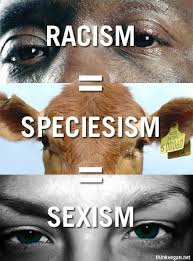

The analogy between speciesism and racism or sexism is also somewhat problematic. The standard for “sentient” beings that the film is discussing about is contradictory in itself since people could also argue that plants or other microorganisms should be treated equally. If animals should be saved from unnatural death, then why not plants? What about bacteria? In this sense, the title of the film is also problematic for it covers only “Animals” instead of  “Earthlings”.
The purpose of the documentary is also questionable. All it does is making us feel bad. Of course, at times presenting a problem that the public is unaware of is helpful for the development of our race. However, the documentary focuses on emotional influence too heavily that it neglects the importance of logical explanation and introduction of the other side of the table. This is why the people who come up with so-called “solutions” after watching this film become vegetarians. Such individual refusal of participation does not improve the situation. Rather, it is merely an excuse for individuals to feel happy about themselves as if their approach will solve the fundamental problem. Thus the sole effect that this documentary has brought upon our society is financial loss for corporations that follow the moral and proper methods in producing products.
The film “Earthlings”, however, does present an important issue to our society. Even though I have defended speciesism, I am against extensive killing of animals for commercial purposes. These animals or “sentient” beings should also be respected. But the presentation of this idea in “Earthlings” has gone astray and lost its value. The selective editing to increase pathos, or emotional response, is the main issue. Another is the ignorance of the necessity for animal vivisection or anesthesia. The universal doctrine that works to minimize the suffering of these animals shows that not all of us are corrupted like the ones’ that appear on the film. Just because there are companies that do not follow the rule one shouldn’t debunk the whole industry and accuse them for what they never did. With a balanced presentation using pathos and logos, the director could have presented a work that is, perhaps less convincing, but much more valuable to us, “Earthlings”. 


After-Dinner Speech

Prompt
21. Standup. The usual method of the standup comedian monologue is apparently casual connections.  For instance, Elvira Kurt once started a monologue with the simple idea of bad hair.  “As a five-year old, you never had bad hair days.  You woke up with hair straight up, and you said, ‘I look great!  I slept in my swimsuit and I feel wonderful!’  Mother made clothes for me—horrible outfits.  She probably laughed herself to death.  I got back at her.  When I told her I was gay I said it was because of those clothes.”  Note the deliberate movement from plain detail to plain detail, with great leaps between the details—the mother making clothes to the coming-out declaration.  We are not expecting this transition (nor for that matter the simpler transition from bad hair to mother making clothes).  But the transitions are funny, and they affect us, shock us even in this day and age.  Write a 600-word standup comedy monologue, fitting it into a story situation you’ve already begun working on.  Don’t make it obvious to your reader that you are doing a stand-up routine—just tell a story as if you were doing a monologue in front of a smoky, irritable audience, with a Late Show talent scout scribbling notes at the bar in the back.

-->This is a little hard to understand and not exactly what I want to try.
-->What I do want to try is an after-dinner speech, in which you stand up and address a problem that exists in our world. Humor would be recommended and to make it more creative the speaker should be something other than human.
ex) This is a Youtube video of the world champion of 2010 WIDPSC. He gave a speach pretending to be a vampire and addressed the issues of pollution, health and so on. It is quite humorous as well.


My after-dinner speech for the WIQ(world individual qualifiers) is about...
Pretending to be Frankenstein to address issues of stereotypes and the media that encourages such stereotypes. The audience is the society of monsters.

Monday, September 24, 2012

[Title Undecided]


     It is one of those days when you just want to lie down on a sandy beach and feel the full breeze of nature flowing from your toes to the tip of your hair.  On a november evening, two people were standing there, on some lonesome beach, enjoying the ocean breeze. Carrying the saltiness, perhaps from the tears of the life in the ocean, of fishes, the wind tickled their faces. The scent of the ocean might have been uncomfortable for someone else, but these two were used to it, or as some might say, insensible to it. 


     The sun was setting on the horizon, setting the sea on fire, and under the rays of the setting sun, each and every one of the sand particles seemed different. One had a crystal-like glow to it. Another had a reddish glow, which might be a reflection of the sunlight. Some were non-reflective. All of them had the smoothness though, coming from the long years in which they were pushed to one side and to then to the other. All of them would have come from the same rock, the same mountain, and carved down by the same waves. But all of them were different. 
     On the other side of that chaotic harmony, the waves were still rolling in and out, each time gently washing the feet of the two, standing there on the seashore. Although those two, a man and a woman, were firmly standing on the sand, they seemed to be moved by the tickling hands of the waves. Washing away the sand each time and filling it with the coolness of the water from miles away, the waves were dancing. Although the two were ignorant about it, the waves came in and out, then came in again as if to give them another chance. 
     The man who had gray hair, but a stern face that might have seen out of place for his age, was looking at the setting sun. The last rays of the sun were focused on the man which made him look all the more stern and sincere. The women, much younger than the man, was standing a couple of steps behind the man. She had moved out of the reach of the waves. Looking at the sun, her blond hair reflected the sunlight and the shadows created on her face emphasized her beauty--and how mismatching she looked in the scene. Her feet were deeply rooted in the sand, covered, and seemed to be scared by the dance of the tide, of the dreams of Poseidon himself. 
     The man took a step forward, trying to enjoy the last moments of the shinning sun. The women retreated another step, looking down at her feet. Then for a moment, she took a glimpse at the sun and the tide. But as if caught for some misdeed, she looked down at her feet again. The wind changed, climbing down from the land to the ocean as if to follow the setting sun. Following the wind, the woman’s danced towards the longing sun.

**Assignment for Mr. Tame from last semester

Sunday, September 9, 2012

[The Martian Chronicles] Quotation


     After the chapter "Rocket Summer", the rest of the story is located in Mars. Through the year 1999, we are told about two expeditions to Mars that have failed. This time, at year 2000, the people on Earth have prepared a third expedition and the first chapter of the year, "the taxpayer" describes the scene from the perspective of a citizen of Ohio. He argues with the control station of the launch site that he, as a good citizen who has payed tax for this whole expedition, has a right to join the team of astronauts.
     The reason for wanting to leave apparently is because there will be an atomic war on Earth in a few years. But behind all that there was a phrase that caught my attention as I read the novel. It was a phrase that the taxpayer said, "anybody with any sense wanted to get away from Earth". Although on the surface, it only referred to the atomic war that was supposed to happen quite soon, however the phrase itself seemed to imply much more. The thought that nobody would want to live on this planed anymore is in a way, a direct criticism to the world of the period in which Bradbury wrote the novel, and also the world in which the reader lives in. I may be over interpreting a simple phrase but for me it was one of the most powerful phrases in the novel up until now.